


As we know, faithful and fruitful lectio divina requires that we grasp the literal sense of a text — what the text says in and of itself, the author’s intended meaning. Given how far removed we are from the language and culture of first century Palestine, this usually means we have a little work to do to “get it.” For the next few paragraphs, I’ll frame out a bit of the literal sense of Sunday’s Gospel, then I’ll move into my own reflection on it.
This Sunday, we will hear the parable of the talents, Matthew 25:14–30. It’s another parable about stewardship and a warning about squandering our God-given blessings and abilities out of fear and laziness (Ignatius Catholic Study Bible).
In this parable, we hear that a man going on a journey entrusts his possessions to his servants and he will render an account of their stewardship upon his return. Exactly how long he would be gone doesn’t really matter. It was a sufficiently long enough time for the servants to multiply the wealth, to bear fruit. On the personal level, as the Ignatius Study Bible points out, the length of time “indicates one’s lifetime, during which God expects his gifts to be cultivated.” As Erasmo Leiva-Merikakis highlights, it is remarkable just how much God entrusts to his servants—to us. So, Leiva-Merikakis titles his chapter on this parable: “But will you trust in my trust in you?” Will you? Will I? We’re left with that question.
The man gives “talents” to each. Some commentators define a talent as a coin. Others refer to it as a unit for measuring weight, like the weight of a precious metal. So, if a talent is fifty pounds, for example, then two talents of gold would be one hundred pounds of gold. I find this understanding helpful because it gets at the literal weightiness of the entrustment. Again, on the personal level, we derive the notion of one’s God-given talent or talents from this parable. These talents are meant to be invested in and shared, and we all benefit from this investment in and sharing of talents (see CCC §1936–7).
The talents were given to each servant according to that servant’s ability. There’s an intimacy worth noting, here, an attentiveness to the uniqueness of each individual. Leiva-Merikakis comments:
Again we see here that God does not love generically or deal with each of us as if we were identical items on an assembly line. We may say, rather, that only God truly knows us precisely as we are and that only he, therefore, can truly love us completely and effectively.1
Because God loves us and knows us this way, he knows our ability, capacity, and power to carry out that which he entrusts to us. “God is faithful and will not let you be tried beyond your strength; but with the trial he will also provide a way out, so that you may be able to bear it” (1 Cor 10:13). Again, regardless of the specific amount of responsibility and how it varies person-to-person, God trusts in us. He trusts in me. In you. And that matters, perhaps more than we care to realize.
I do think rivalry’s a constant temptation in the spiritual life. Social media culture inundates our lives with opportunities for comparison. It’s easy to get swept away in one-upmanship or a kind of spiritual self-pity because you’re not stacking up to the saints you’re trying to emulate, those Saint GOATs you’ve identified. Or you’re not checking all the boxes on the laundry list of prayers and ascetical practices you determined for yourself or some app spit out for you. We must remember that God deals with each of us as we are and according to our ability. An algorithm can’t do that. Only God can; and God does. He meets us in our circumstances. He gives us our circumstances as the playground for the talents and virtues he’s given us. Woe to us if we miss all of this because we’re busy comparing ourselves and trying to be someone else’s saint instead of God’s.
Going back to the parable, two of the servants risk, trade, and double up: the servant with five talents ends up with ten and the servant with two ends up with four. Out of fear, the servant with one buries his and makes no return on the man’s investment despite the fact that he could have at least put the talent in the bank which would have yielded a significant ROI at the time (according to the Jerome Biblical Commentary). The fact that the master is demanding and the servant knows this makes his cowardly action more deplorable. He should have pursued some kind of financial undertaking. The servant knew better and still chose inactivity. He suffers from a lack of magnanimity that goes by the name of acedia in the list of the eight evil thoughts. Risk vs. fear. Faith vs. fear. That’s what’s at stake, here.
With the man’s return comes the time for reckoning, the time for judgment. Those servants who risked and were rewarded and praised and given greater responsibility. But the master denounces the one who buried his talent out of fear. He calls him wicked and lazy. He takes the talent from him and gives it to the servant with ten, for the one to whom much is given, much will be required (cf. Luke 12:48). Now, for the one who has nothing, even that nothing will be taken away—a hyperbolic statement if ever there was one, and he’s cast into the hell of non-relationship that’s signified by darkness, wailing, and the gnashing of teeth.
Finally, I want to touch on the strange piece of the parable around the master being a demanding person who harvests where he didn’t plant and gathers where he didn’t scatter. If the man who goes off on a journey symbolizes God more generally, or Jesus more specifically, the description of his character is a bit off-putting. Let’s look at the positive side, first. Isn’t it the case that God is ruthless in his pursuit of profit (i.e., our holiness)? Isn’t this a good thing? And, the fact that he gathers and reaps that which isn’t his. Well, in CS Lewis’s Screwtape Letters, Uncle Screwtape frequently bemoans the unfair advantage God has over the demons. I mean, these poor demons spend all this time and energy sowing wicked seed into a person’s lifetime only for God to come in in the eleventh hour for the save. How unfair is that?! God doesn’t play by the rules of our fallen world. He stands above it. After all, he is a grave robber and one who defeated death at its own game. If God is about this kind of ruthless pursuit of profit, are we about it in our own lives and in carrying out the evangelical mission entrusted to us?
Being entrusted with the message of salvation entails great responsibility. To sit on that message or to bury it for ourselves is a serious breach of responsibility to the Lord, who calls us to share his good news with the world. He does not want us to give it back to him unshared and unfruitful.2
Prayerful Reading
My reflection on this Gospel has centered around:
YOUHAVEBEENFAITHFULOVERAFEWTHINGS
The NAB translates this: faithful in small matters.
I have been thinking a lot about these small matters, because the small matters trip me up. I overlook the small matters. I grumble when my son needs his shoe tied for the fifth time in ten minutes. I become irritable over the number of pots I need to wash after dinner for ten. I get impatient with the person driving so slow in front of me. I am too tired to sit up and pray attentively. I check my text messages instead of listening to the person in front of me. I say that sarcastic remark that I know will sting, then try to cover it up with some excuse. Any number of things, really. The few, small things. The few, small things that can’t be overlooked. The few, small things that make the biggest difference, I think, on the path to holiness. They make the biggest difference because the path to holiness goes through the here-and-now and the here-and-now is littered with seemingly small, ordinary, and meaningless things. Yet when set in the context of the whole and of the goal of life as it’s revealed in Christianity, they’re no longer so small, so banal, so meaningless.
Lately, I’ve found myself reflecting on a line attributed to Dorothy Day: “Everybody wants a revolution, but nobody wants to do the dishes.” Everybody wants to do the big thing, the glamorous thing, the risky thing—the thing that will get all the attention and win the awards. Nobody wants to do the dishes. Nobody wants the necessary thing that gets no attention. Of course Dorothy’s exaggerating a bit, but she makes the point clear. And the point is that pride and the puffed up ego remains a constant threat to us all. (Maybe I need to ask "Our Lady of Homework” to intercede for me in my need.)
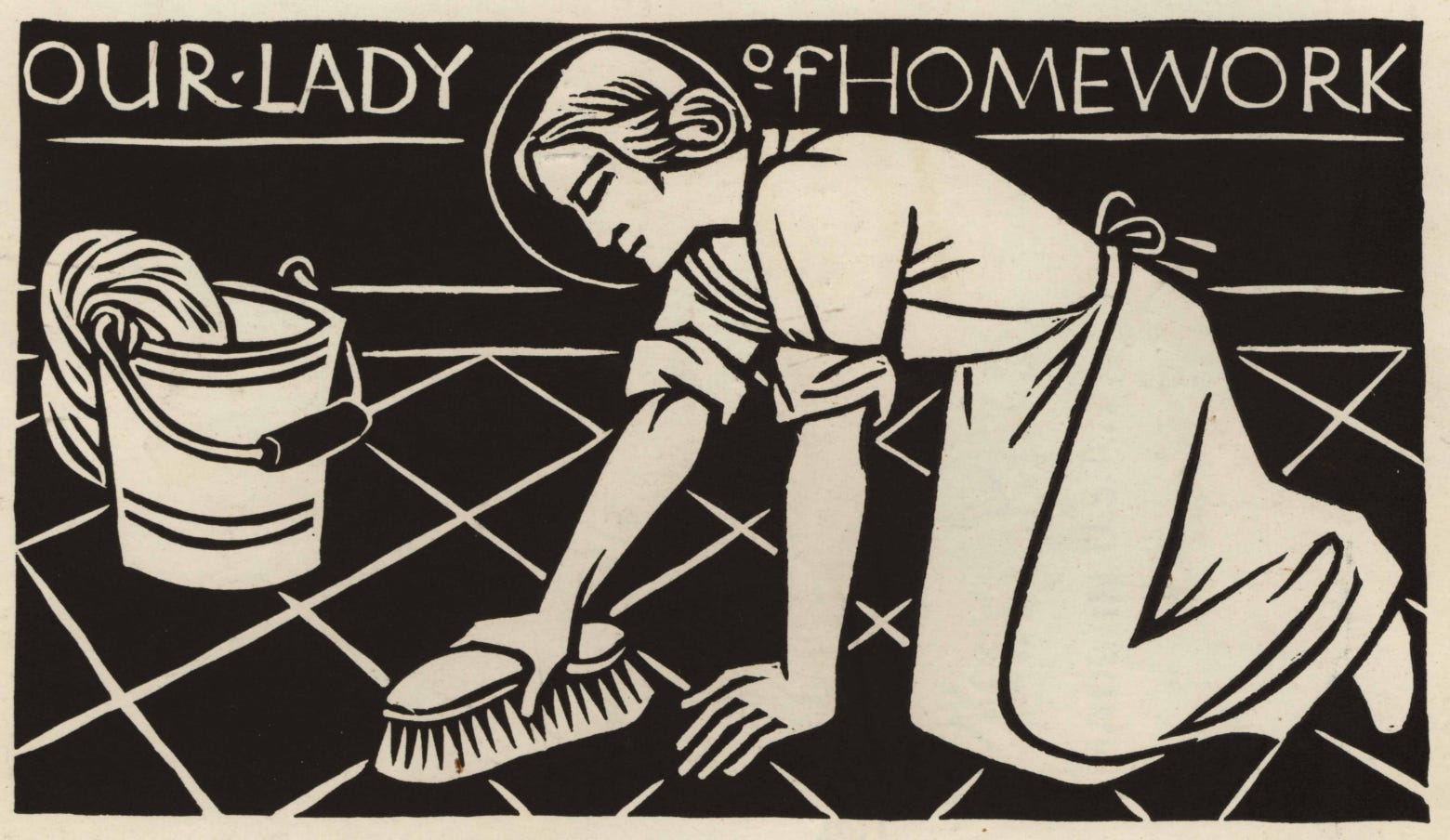
I guess one more point on this business of small matters. We never really know what will come from these little things, at least not on this side of the grave. So, I’ll conclude with one more from Dorothy along this line:
What we do is very little, but it is like the little boy with a few loaves and fishes. Christ took that little and increased it. He will do the rest. What we do is so little we may seem to be constantly failing. But so did He fail. He met with apparent failure on the Cross. But unless the seed fall into the earth and die, there is no harvest. And why must we see results? Our work is to sow. Another generation will be reaping the harvest.
In the parable of the talents, the servants were entrusted with what the master had for each of them according to the ability of each. The same holds for us. As I said above, it doesn’t matter who has more “talents” and who has less. What matters is that God has entrusted these talents to each of us according to our ability and only you can invest and grow your talents and only I can invest and grow mine. By you growing and sharing yours, I am blessed and vice versa.
In the end, any investment of ours is a truly small matter, a little thing particularly in comparison with God’s investment in humanity. We’re called to risk the little things we have been given for the sake of glorifying God, and we must remember that Christ is ultimately the one who takes these little things and makes them into something great. Sometimes the risk seems to work out; sometimes it doesn’t. I heard once that “he who does not risk does not win.” I think that’s true. But it’s also true that in the Christian sense winning doesn’t always look like the world thinks it looks. Winning looks like being faithful to the call, regardless of the result. In this light, even apparent failures can be wins, maybe even the biggest wins. As Mother Teresa says, “God has not called me to be successful; He has called me to be faithful.”
So we keep focused on the Lord above all else and pray against becoming self-righteous for any of our good deeds or positive outcomes. We pray against the inflated ego. And, since I’ve gone this far, I’ll tack on one more from Dorothy Day to round out my reflection this week:
I suppose it is a grace not to be able to have time to take or derive satisfaction in the work we are doing. In what time I have, my impulse is to self-criticism and examination of conscience, and I am constantly humiliated at my own imperfections and at my halting progress. Perhaps I deceive myself here, too, and excuse my lack of recollection. But I do know how small I am and how little I can do and I beg You, Lord, to help me, for I cannot help myself.
PS. Thank you to those of you who prayed for me and my wife as we were received as Benedictine oblates last weekend. For those interested in learning more, I’ve written a brief article about this experience here (and I included some pictures, too).
Please use the comments to share your own lectio reflections if you’d like. It’s always a blessing to experience lectio within community — even online!
A reminder that paperback editions of my books are available on the Wipf & Stock website for 50% off. Simply visit my author page and then use the code CONFSHIP when you checkout.
Leiva-Merikakis, Fire of Mercy, Heart of the Word, 804.
Mitch and Sri, The Gospel of Matthew, 324.
Benedictine Oblates! Congratulations. I appreciated your take on the demanding master, that’s what struck me today and I didn’t know what to do with it.