


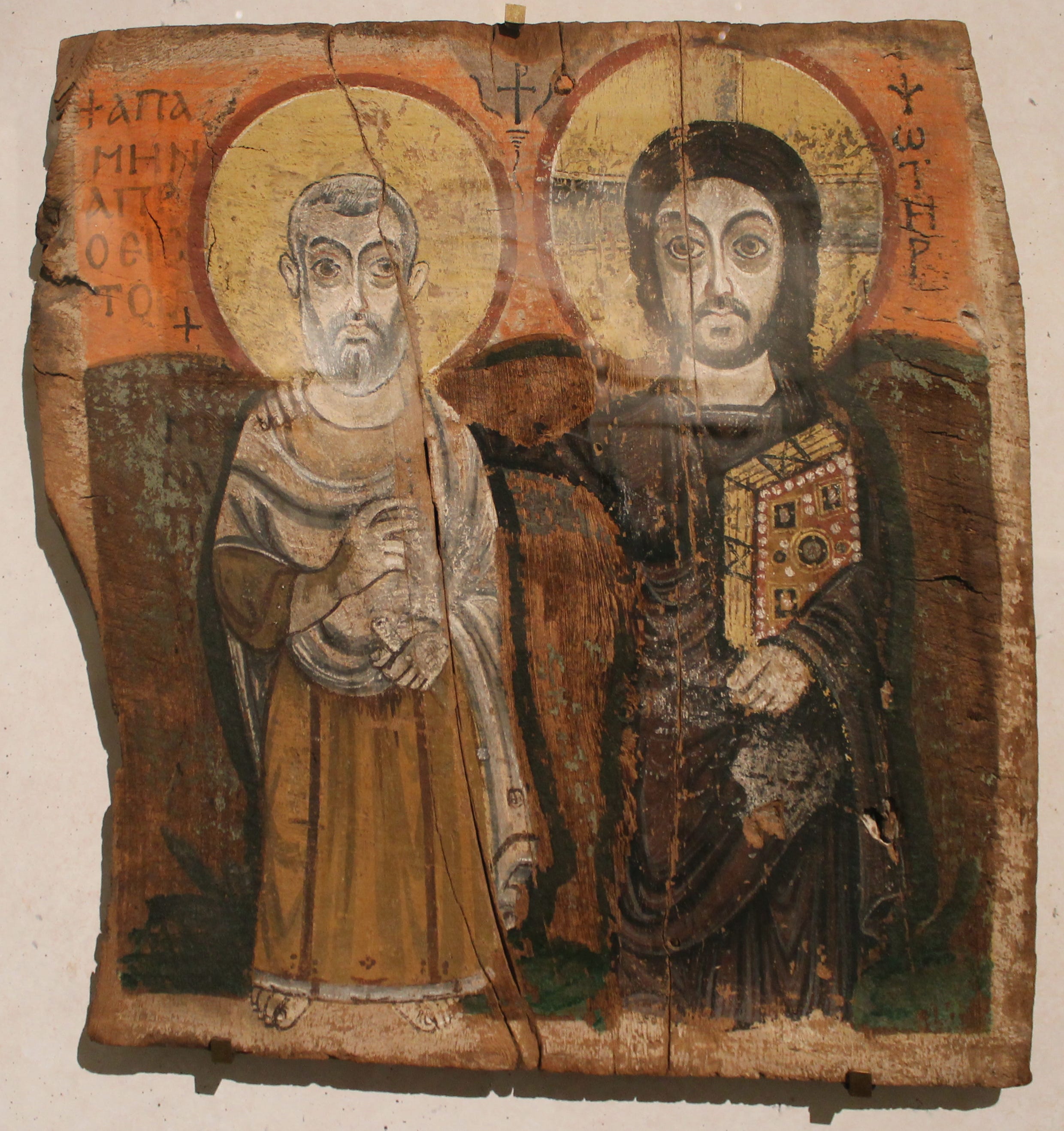
The ancient Coptic icon clearly depicts an invitation to friendship with Christ, which, we can say, is the goal of the Christian life. Such friendship is also the goal of lectio. In its own way, then, the icon of “Christ and Abbot Mena” (AKA “Christ and his friend”), invites reflection on the mystery of lectio divina.
Jesus stands to the right. He has a cruciform halo and stands taller is taller than the other figure. He is greater because he is Lord. Inscribed to the right of Jesus’ head is the word “Savior” in Greek, which identifies a critical part of his relationship to us. Jesus has one eye on his friend and the other one on the viewer. He sees his friend and he sees me. He sees you. The hidden one we’ve been seeking sought us in our own hiding (see John 1:35–42 and Gen 3:9). By hiding his divinity in flesh, he found us there and still does.1 Jesus holds a jewel-studded Bible, showing us that he is the One we encounter in the words of Scripture. He is the key to unlocking the meaning of Scripture, and Scripture is key for hearing the voice of the Lord.
Then, we have the figure of the good, saintly abbot. Surely, he’s struggling through all the things any abbot—or priest, or abbess, or father of a family, or mother of a family, or brother, or sister—struggles through. Abbot Mena’s head is haloed, and his inscription reads “Father Mena, guardian.” He’s the guardian or superior of his monastery. Mena’s trying to be a good shepherd, and here is Christ, the Good Shepherd shepherding him. Jesus is guiding him into Scripture and guiding him in life. Mena holds a scroll, possibly the rule of his monastic community, and he, too, has one eye on Christ and one eye looking out. He can only bear credible witness to Christ “out there” to the extent in which he is abiding with Christ, in intimate relationship with him (cf. Mark 3:13–15).2 Finally, we note Abbot Mena raising his hand in blessing (see CCC, §2626). He is blessing Christ in return, but in return for what?
An embrace.
The whole scene is wrapped in an embrace. Jesus, draws close to the abbot, puts his arm around him. It’s an image of protection. He places the abbot under the wing of his protection. “Under his wings you may take refuge” (Ps 91:4). This is also a gesture of intimacy, vulnerability, and friendship. He is also pulling the abbot closer to his heart, collapsing the distance between them. The icon invites us to consider how he does this for us, too. “Come to me, all you who labor and are burdened, and I will give you rest” (Matt 11:28), for “I no longer call you slaves . . . I have called you friends” (John 15:15). In collapsing the distance and drawing the abbot closer to his heart, he draws him deeper into his mystery contained in the Gospels. At the same time, the words of Scripture lead us to the heart of Christ. We come to the heart of the Lord via Scripture. Encountering God’s heart in Scripture and abiding in the Word, this is lectio divina. Lectio collapses the distance between God’s heart and mine. It is an intimate encounter—heart-to-heart.
Joseph Ratzinger has some beautiful passages on the hiddenness of God in Jesus Christ and God’s way of humility, smallness. For example, see Ratzinger, Introduction, 149–50, 255–256; and Benedict XVI, Jesus of Nazareth: The Infancy Narratives, 66–67.
For more, see Erasmo Leiva-Merikakis, Way of the Disciple, 38; Benedict XVI, Jesus of Nazareth: From the Baptism in the Jordan to the Transfiguration (San Francisco: Ignatius, 2007), 170–2.